
Troup County Criminal Case Files
A criminal court record begins once charges are filed with a court and the case moves onto the court docket. In Troup County, felony criminal files are handled in Superior Court within the Coweta Judicial Circuit. State Court handles misdemeanor criminal violations, traffic cases, and ordinance matters within its jurisdiction. Magistrate Court is important at the front end because it issues countywide arrest warrants, conducts first appearances within 48 to 72 hours for jailed defendants, sets bail when warranted, and schedules committal hearings. Municipal courts handle city traffic, DUI, shoplifting, small marijuana, parking, animal-control, and local ordinance matters when those cases remain at the city level.
The court case file is different from the arrest record. It can include the accusation or indictment, warrant, bond entry, arraignment, plea, motions, discovery orders, docket entries, sentence, probation terms, revocation entries, and final disposition. For the charge-by-charge path immediately after arrest, use the Troup County arrest records and court charges page. The criminal court record remains the case file and the court's outcome record.
The Troup County District Attorney page identifies the felony prosecution office for local criminal cases.

The District Attorney channel matters because felony charging, indictment, victim services, and felony record-restriction routing involve the prosecutor.
Search Troup County Criminal Court Records
Start with the Clerk of Superior and State Courts when the criminal case is in Superior Court or State Court. The Clerk website links case-search, calendars, forms, fees, and e-filing resources. The older official portal includes a Case Search link, but research found that direct form access may be restricted during static inspection. For immediate docket activity, the Clerk posts State Court criminal calendars and Superior Court criminal calendars. For a certified disposition, sentence, or copy of a filed criminal document, contact the Clerk rather than relying on a calendar entry.
- Identify whether the matter is felony, misdemeanor, traffic, ordinance, warrant-stage, or municipal.
- Check the Clerk calendar pages for current Superior Court or State Court criminal settings.
- Use the official case-search link if available, searching by defendant name or case number.
- Review docket entries for arraignment, plea, motion, trial, disposition, sentence, or probation-revocation events.
- Request certified copies from the Clerk of Superior and State Courts when proof of outcome is needed.
State-level criminal-history access is separate from Troup County criminal court records. The Georgia Bureau of Investigation handles criminal-history record restriction information, while court files remain with the court that heard the case. A statewide background-history result may not show every document in the local court file, and a local court docket may not function as a consumer background report.
Troup County Criminal Case Flow
Criminal court records become clearer when read in sequence. A Troup County case may start with an arrest warrant or citation, move through first appearance and bond, then proceed to formal charging in Superior Court, State Court, or a municipal court. The filed court record tracks each step after the court receives the case. Some charges are amended, transferred, dismissed, dead docketed, pleaded, or tried. The final record should be read at the charge level because one defendant can have several counts with different results.
Case flow: Charges Filed › Arraignment › Pretrial / Motions › Plea or Trial › Disposition › Sentencing
| Stage | What Happens |
|---|---|
| First appearance | Magistrate Court addresses rights, custody, bail, and early probable-cause issues for jailed defendants. |
| Arraignment | Charges are formally presented, and the defendant enters a plea. |
| Pretrial / motions | Lawyers file requests, discovery issues are addressed, and hearings may be set. |
| Plea or trial | The case resolves by plea, bench trial, jury trial, dismissal, or another court-approved outcome. |
| Disposition and sentencing | The court records the charge result, sentence, probation, costs, restitution, or revocation terms. |
The Coweta Judicial Circuit District Attorney site gives circuit context for Troup County felony prosecution.
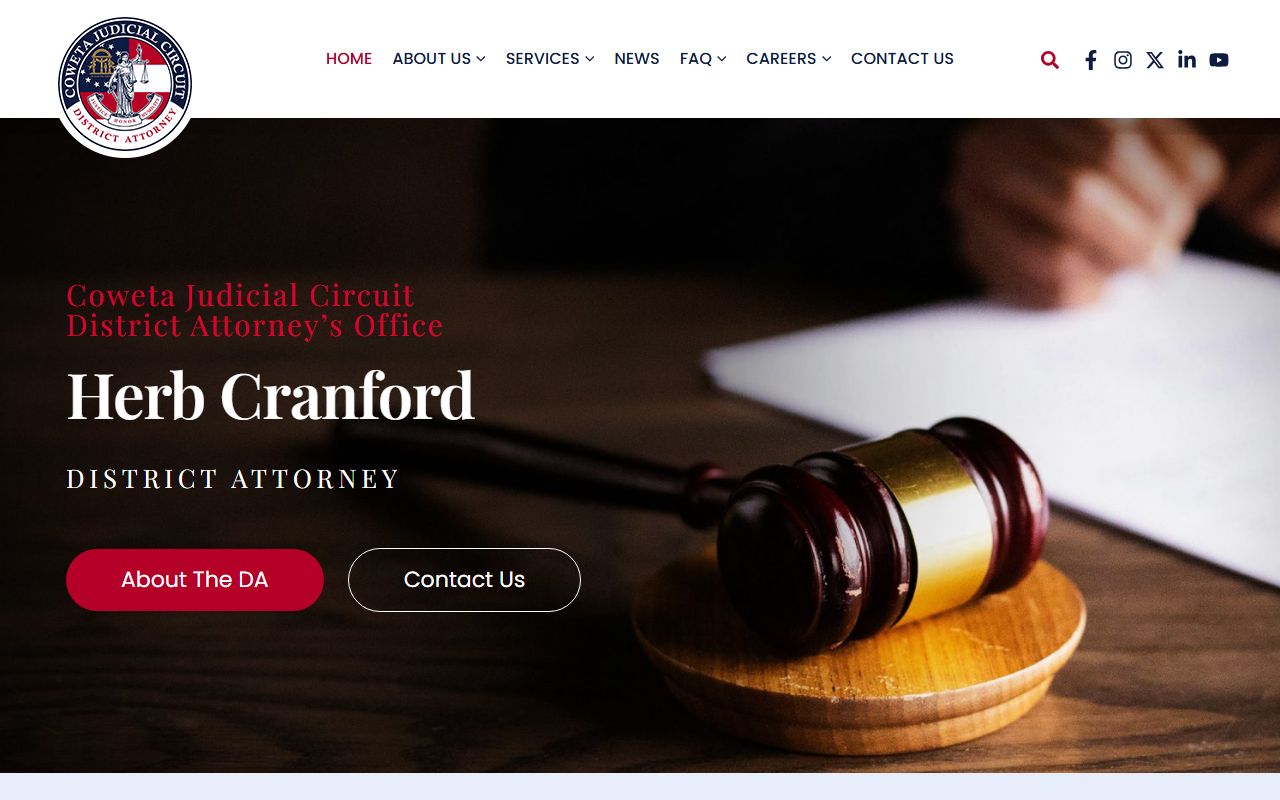
That circuit context is important because Troup County Superior Court felony prosecution is part of the Coweta Judicial Circuit.
What Troup County Criminal Records Show
A Troup County criminal court record should be read as a court file, not just a charge list. It can identify the court, judge, defendant, case number, prosecutor, defense counsel, arresting or originating agency, filed charge, offense date, warrant number, bond action, hearing dates, motions, plea, verdict, disposition, sentence, probation terms, and financial obligations. Calendar postings may show only a piece of that record. Certified copies and complete documents come from the court office that maintains the file.
| Field | What It Shows |
|---|---|
| Case number | The court identifier used to track filings, hearings, and final orders. |
| Defendant | The person accused in the criminal case. |
| Charges | The filed felony, misdemeanor, traffic, or ordinance counts and any charge changes. |
| Attorneys | District Attorney, Solicitor, public defender, appointed attorney, retained counsel, or self-represented status. |
| Docket entries | Arraignment, motion, bench trial, jury trial, pre-trial, bond forfeiture, or probation revocation events. |
| Plea | The defendant's formal answer to each charge. |
| Disposition | The final result for each charge, such as guilty plea, acquittal, dismissal, or nolle prosequi. |
| Sentence | Jail, prison, probation, fines, costs, restitution, conditions, or revocation terms. |
Troup County Charges vs Convictions
A charge means the state has accused a person of an offense. A conviction means the charge ended in a guilty plea, guilty verdict, or other conviction-level result. Troup County criminal court records can show both charges and final outcomes, and those should not be treated as the same thing. One case may include a dismissed count, a reduced count, a plea on another count, and a sentence tied only to the count that ended in conviction.
| Charge | Conviction | |
|---|---|---|
| Meaning | An accusation filed by the state or presented through indictment. | A final guilty outcome by plea, verdict, or accepted disposition. |
| Timing | Appears early in the criminal case record. | Appears after plea, trial, or final disposition. |
| Proof level | Based on charging and probable-cause standards. | Based on conviction-level proof or a valid plea. |
| Record reading | Check whether it was amended, reduced, dismissed, or dead docketed. | Check sentence, probation, costs, and restrictions. |
The Troup County Solicitor page identifies the State Court misdemeanor, traffic, and ordinance prosecutor.
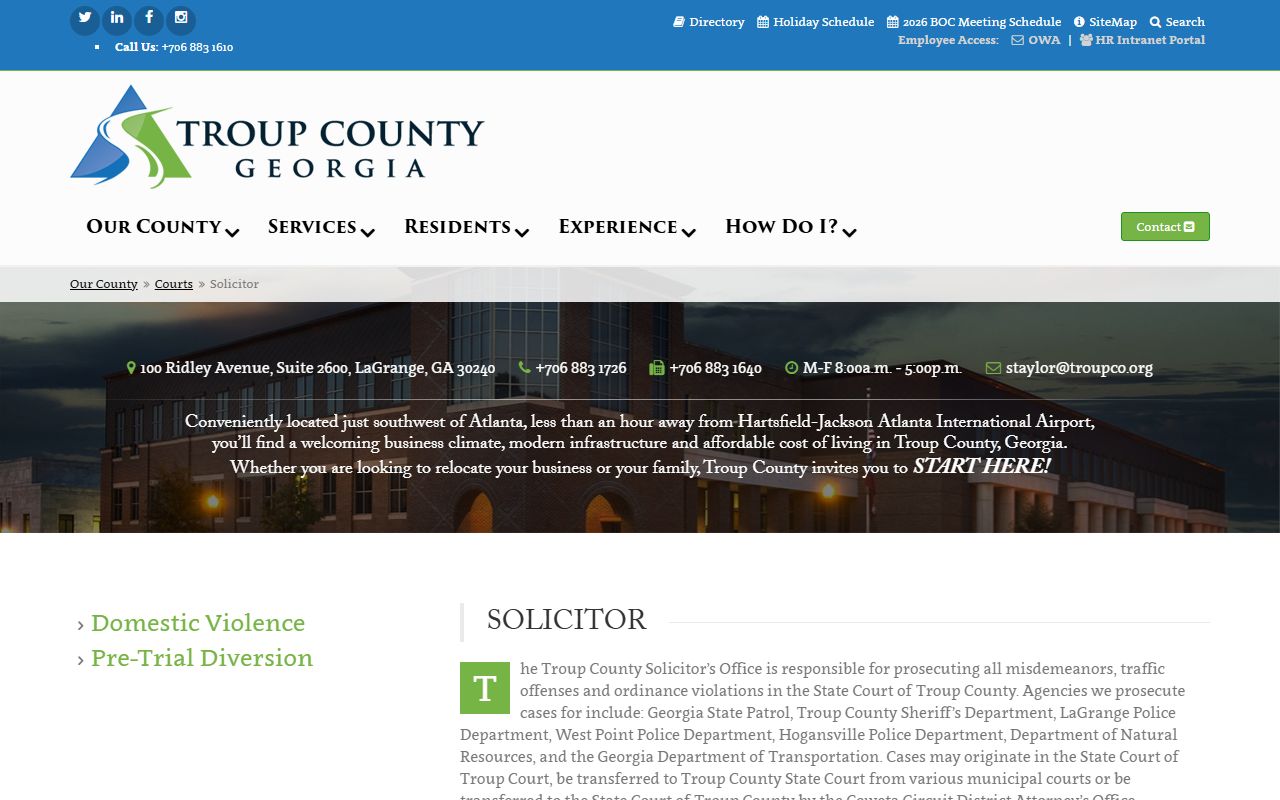
The Solicitor's role is central for State Court misdemeanors, traffic offenses, ordinance violations, and many lower-level criminal docket events.
Read Dispositions and Sentences
Disposition means the final outcome of a case or charge. Common outcomes can include guilty, not guilty, dismissed, nolle prosequi, dead docket, transferred, or probation revocation. Sentence means the punishment or court order after conviction or plea. In Troup County criminal records, a sentence may include jail, prison, probation, fines, costs, restitution, treatment, accountability-court conditions, or other release conditions. A probation revocation entry does not always mean a new conviction; it may allege or decide whether the defendant violated existing probation terms.
- Arraignment
- A hearing where charges are formally presented and a plea is entered.
- Disposition
- The final outcome of a case or charge.
- Sentence
- The punishment or court-ordered conditions after conviction or plea.
- Dead docket
- An inactive criminal case status used in Georgia practice.
Troup County Sealed vs Restricted
Georgia often uses the term record restriction for limiting public criminal-history access. The GBI states that O.C.G.A. 35-3-37 governs review, correction, and restriction of Georgia criminal-history records. For arrests after July 1, 2013 that did not result in conviction, GBI directs people to the prosecutor rather than a separate GBI application. In Troup County, that may mean the District Attorney for felony matters or the Solicitor for State Court misdemeanor and traffic matters.
| Restricted Criminal History | Sealed Court File | |
|---|---|---|
| Focus | Limits public dissemination of qualifying criminal-history records. | Limits public access to a court file or document. |
| Route | Often prosecutor or arresting agency, depending on arrest date and result. | Usually requires court authority or a specific statute. |
| Effect | Does not erase every docket, archived paper file, or outside reference. | Can hide or redact filings from public inspection. |
The GBI record restriction source explains Georgia's criminal-history restriction process.
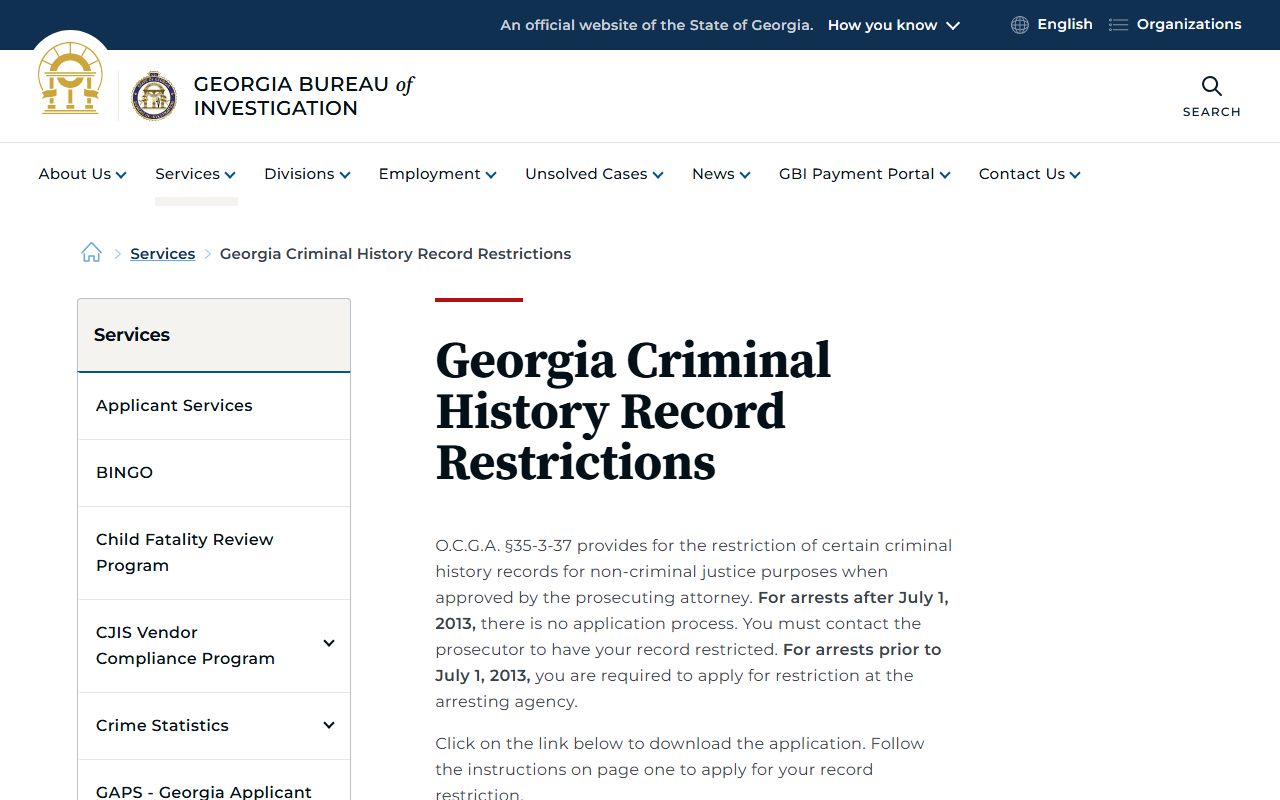
Use that source for Georgia restriction rules, while using the Troup County court and prosecutor offices for the local case file and court orders.
Public Access to Troup Criminal Records
Georgia's public-record framework and court-file rules support access to many adult criminal court records, but access can be limited by statute, rule, or order. Juvenile files are separate and often confidential. Sealed filings, restricted criminal-history records, adoption-related material, protected identifiers, and sensitive mental-health material are not treated as ordinary open files. Court calendars can be public while the underlying document remains unavailable online or subject to redaction.
Key Statutes:
O.C.G.A. 50-18-70 supports prompt inspection of public records unless an exception applies.
O.C.G.A. 50-18-72 lists exemptions where disclosure is not required.
For certified criminal case outcomes, contact the Clerk of Superior and State Courts at 100 Ridley Avenue, Suite 1600, LaGrange, Georgia 30240, phone 706-883-1740. For appointed counsel questions, the local Court Appointed Attorneys/Public Defender office is at Suite 2501, phone 706-883-2168, while the Superior Court Public Defender office is listed at 2508 Hamilton Road, LaGrange, phone 706-883-3000.