
Troup County Arrest Records and Charges
Troup County arrest records usually begin with the arresting agency, jail booking process, warrant or citation, and first court appearance. The Sheriff's Office and jail side may show current custody, name or ID, arrest date and time, and sometimes charge or bond detail when available. The full jail-roster and custody workflow belongs with inmate records, but the arrest record is the first trace of the arrest-to-court path.
Court charges after arrest begin when the prosecutor or charging authority files a formal charge in the correct court. Felony charges usually involve the Coweta Judicial Circuit District Attorney and Superior Court. Misdemeanor, traffic, and ordinance prosecutions in State Court involve the Troup County Solicitor. Magistrate Court often appears first because it issues countywide arrest warrants, conducts first appearances within 48 to 72 hours for jailed defendants, sets bail when warranted, and schedules committal hearings. The full case file and outcome are covered in Troup County criminal court records.
The Troup County State Court page describes the local court that hears many misdemeanor and traffic charges.
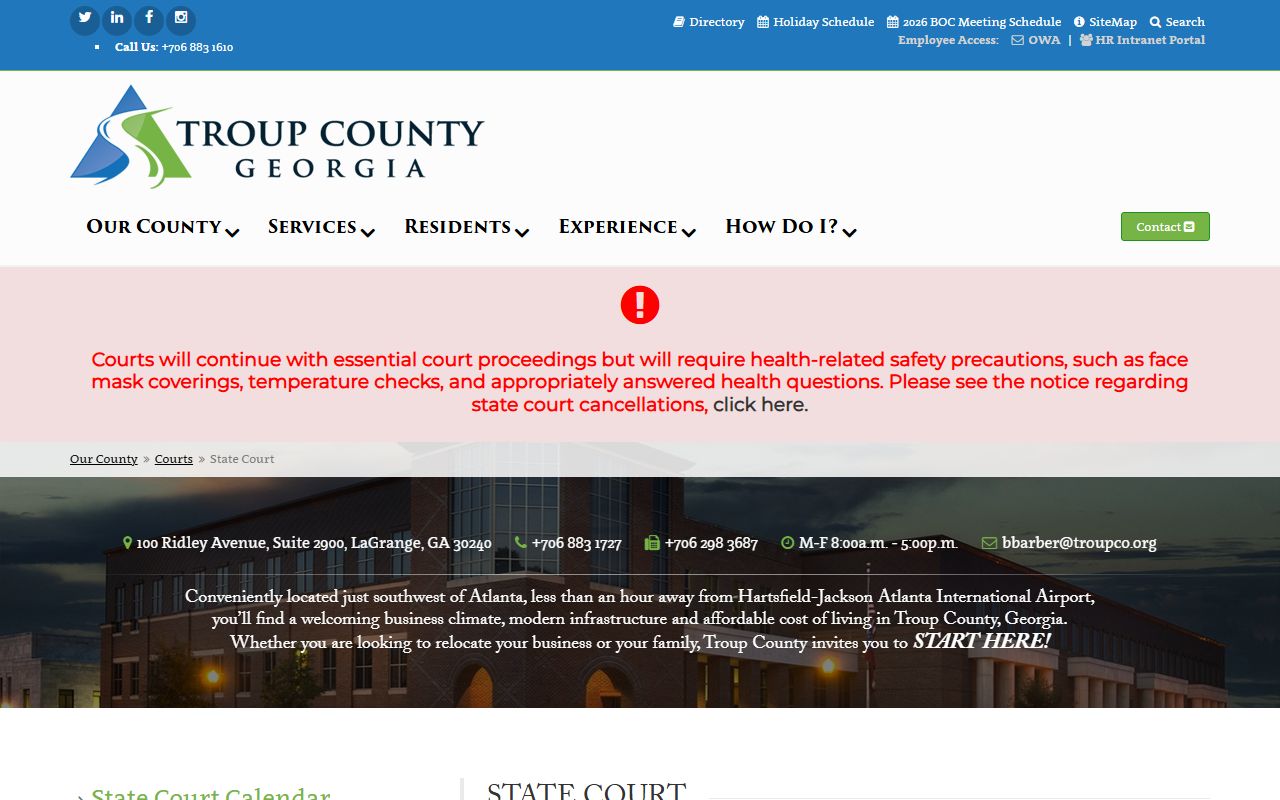
State Court matters because many misdemeanor, traffic, and ordinance charges after arrest are prosecuted there rather than in Superior Court.
Find Troup County Arrest Records
Use the correct channel for the part of the record needed. Current custody and booking detail start with the Troup County inmate records search or Sheriff's Office. Warrant, first appearance, bond, and committal-hearing information can involve Magistrate Court. Filed felony charges route to Superior Court and the District Attorney. Filed misdemeanor, traffic, and ordinance charges in State Court route to the Solicitor and Clerk of Superior and State Courts. Municipal tickets or city ordinance charges may remain with LaGrange or Hogansville municipal courts.
- Identify the arresting agency and whether the person is currently in the county jail.
- Check the jail or inmate-record channel for custody and arrest-date information when current custody is the issue.
- Contact Magistrate Court for warrant, first appearance, bail, or committal-hearing records.
- Search or request the court case file from the Clerk when charges have been filed.
- Read the disposition before treating any filed charge as a conviction.
Georgia.gov warrant guidance says warrant information should be requested from the local sheriff for the county. For Troup County, the Sheriff's Office is at 130 Sam Walker Drive, LaGrange, phone 706-883-1616. For county court charge records, the Clerk of Superior and State Courts is at 100 Ridley Avenue, Suite 1600, phone 706-883-1740.
Charges After Arrest in Troup County
The charging document controls what the court is asked to decide. It may not match the arrest wording exactly. A charge can be changed after review by the District Attorney or Solicitor, after a grand jury action, after a plea negotiation, or after a court ruling. In Troup County, felony prosecutions use the District Attorney and Superior Court, while State Court misdemeanor, traffic, and ordinance prosecutions use the Solicitor. Cases may also originate in State Court, transfer from municipal courts, or transfer from the District Attorney to the Solicitor.
| Complaint | Accusation / Information | Indictment | |
|---|---|---|---|
| Filed by | Officer or prosecutor, depending on stage. | Prosecutor. | Grand jury. |
| Common use | Early warrant, citation, or misdemeanor-stage record. | Misdemeanor or prosecutor-filed criminal case. | Felony prosecution requiring grand-jury action. |
| Record role | Starts or supports the court charge path. | Defines charges the court will hear. | Sets felony counts presented to Superior Court. |
The O.C.G.A. 15-7-4 source gives the Georgia State Court jurisdiction rule for these charge records.
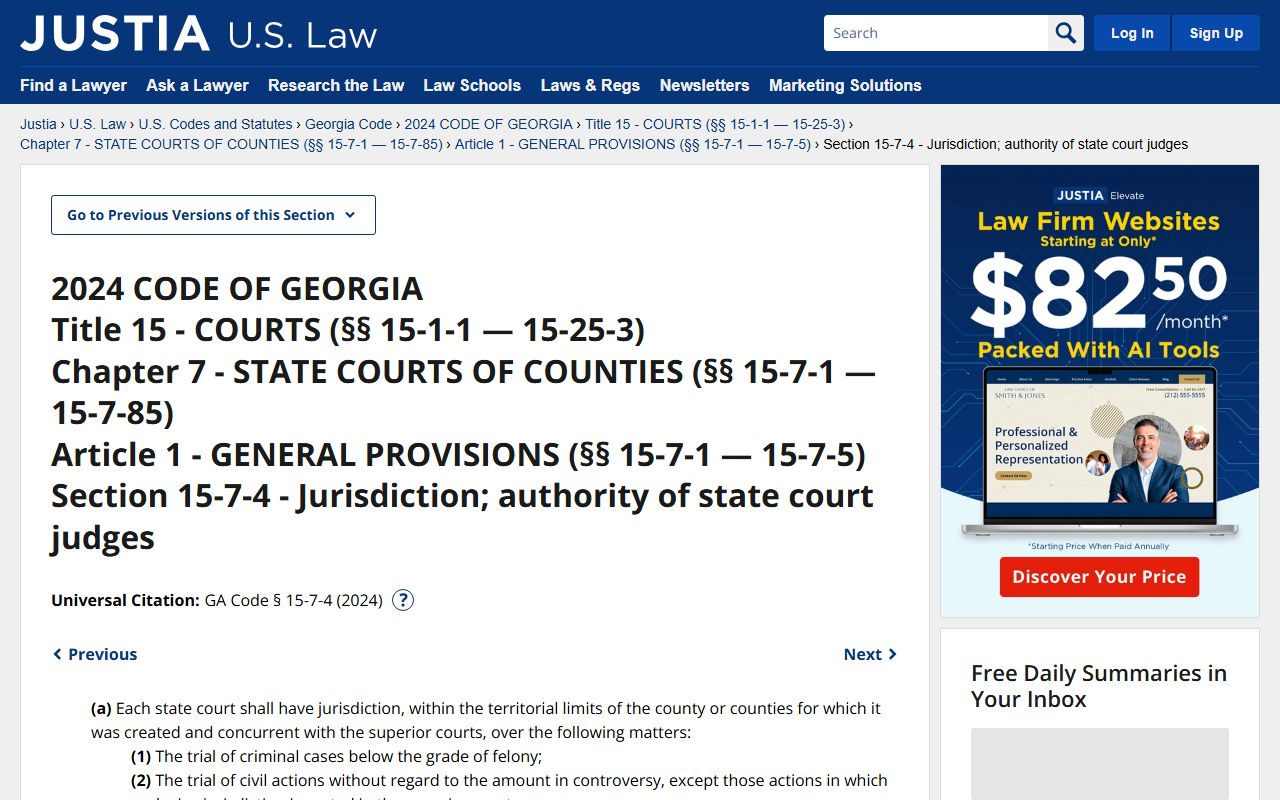
That statute supports why State Court is a major venue for Troup County misdemeanor, civil, and traffic-type matters.
Troup County Charge Status Terms
Charge status is the most important part of any court charge record. A filed count can remain pending, be amended, be reduced, be dismissed, be dead docketed, or end in plea or verdict. A case can also contain multiple charges with different outcomes. For that reason, a charge list by itself is not enough. Read the docket entries and final disposition for each count.
| Status | What It Means |
|---|---|
| Pending | The court has not entered a final result for the charge. |
| Amended | The filed charge or wording changed after filing. |
| Reduced | The charge level or offense was lowered, often through prosecutor action or plea discussion. |
| Dismissed | The court or prosecutor ended that charge without a conviction on that count. |
| Nolle prosequi | The prosecutor declined to continue prosecution of that charge. |
| Dead docket | The criminal case or count was made inactive under Georgia practice. |
Troup County Charges vs Convictions
Being arrested or charged is not the same as being convicted. Troup County arrest records may show that a person was booked or accused. Troup County court charge records may show what was filed after arrest. A conviction appears only after the charge reaches a conviction-level outcome, such as a guilty plea or guilty verdict. One arrest can produce several charges, and one case can close with several different outcomes.
| Charge | Conviction | |
|---|---|---|
| What it means | An accusation filed or presented in court. | A final guilty outcome by plea or verdict. |
| Where it appears | Warrant, accusation, indictment, citation, docket, or case record. | Disposition, sentence, judgment, or final docket entry. |
| Can change | Yes, it may be amended, reduced, dismissed, or dead docketed. | Only after post-judgment action, appeal, restriction, or court order. |
| How to read it | Check current charge status. | Check sentence, probation, costs, and restrictions. |
Who Files Troup County Charges
The Coweta Judicial Circuit District Attorney handles felony charge filing and prosecution for Troup County Superior Court matters. The county DA page identifies John Herbert Cranford Jr. as District Attorney, while the DA site visible text uses Herb Cranford. Because the research found a small circuit-county wording mismatch between the county page and DA site, the safest build language is to use the Coweta Judicial Circuit District Attorney for felony charge records and verify current circuit details with the official office when needed.
The Troup County Solicitor is Sandra Taylor. The Solicitor prosecutes all misdemeanors, traffic offenses, and ordinance violations in State Court. Agencies listed for State Court prosecution include Georgia State Patrol, Troup County Sheriff's Department, LaGrange Police, West Point Police, Hogansville Police, Department of Natural Resources, and GDOT. The Solicitor appears for traffic court, status hearings, jury trials, arraignments, bench trials, probation revocations, non-English arraignments, bond forfeitures, criminal pre-trials, magistrate committal hearings, and magistrate pre-execution hearings.
Troup County Solicitor
100 Ridley Avenue, Suite 2600
LaGrange, GA 30240
706-883-1726
Email: staylor@troupco.org
Arrest to Court Charge Path
The arrest-to-charge path in Troup County can involve several offices. A law-enforcement agency makes the arrest or writes the citation. The jail or Sheriff's Office creates custody and booking records. Magistrate Court handles arrest warrants, first appearance, bail, and committal hearings for jailed defendants. The prosecutor then decides the formal charge path. The Clerk keeps the court file once the charge is in court. If the person misses a hearing, a bench warrant or failure-to-appear entry can appear in the court record and warrant channels.
Local flow: Arrest or citation › booking or warrant record › first appearance and bond › prosecutor review › filed charge › docket events › disposition.
For current custody and jail roster details, use the Troup County inmate records page instead of treating a court charge page as a jail blotter.
Note: A jail booking entry may be current while the formal court charge record is still developing.
Restricted Troup County Charge Records
Georgia record restriction can limit public criminal-history dissemination for certain arrests that did not result in conviction. O.C.G.A. 35-3-37 governs review, correction, and restriction of criminal-history records. The GBI says arrests after July 1, 2013 generally route through the prosecutor when they did not result in conviction; older arrests may require an application with the arresting agency. In Troup County, that means the District Attorney for felony matters and the Solicitor for misdemeanor or State Court matters, depending on the case.
| Restricted | Still Visible Elsewhere | |
|---|---|---|
| Criminal history | May be limited for non-criminal-justice access if eligible. | Court dockets or archived files may need separate handling. |
| Juvenile matter | Often confidential under juvenile rules. | Public adult-style name searches should not be assumed. |
| Sealed filing | Requires law, rule, or court order. | A redacted public version may still exist. |
Access Court Charges After Arrest
Use the Clerk of Superior and State Courts for filed Superior Court and State Court charge records. Use Magistrate Court for arrest warrants, first appearances, bail, and committal hearings. Use the Sheriff's Office for active warrant inquiry, arrest-agency records, or jail-linked booking records. Use municipal courts for city tickets and ordinance matters. When a record is not online, the Troup County JustFOIA portal can support public-record requests, but court-file copies and certification still may require the court office that keeps the file.
Public access is shaped by O.C.G.A. 50-18-70, O.C.G.A. 50-18-72, criminal-history restriction law, juvenile confidentiality rules, and court orders. Read the charge, status, disposition, and sentence together. That is the only reliable way to distinguish an arrest, an accusation, a dismissed charge, and a conviction in Troup County court records.